

What should an Idaho CHIS DDA look for in scheduling software?
Start with what Idaho's rules put on the schedule. Then judge each tool on the repairs your scheduler makes week after week: covering call-outs, handling time off, and keeping supervision and PST current.
Look for software that carries the checks Idaho's CHIS rules put on your schedule, and that speeds up the repairs your scheduler makes each week, such as a sick call or a family cancelling. Under IDAPA 16.03.26, each child's sessions have to stay inside the prior-authorized hours and be delivered by someone at the qualification level the authorization names. BIs (behavior interventionists) at the technician and specialist levels need supervision every month, with the child present for the observation. Under the DDA rules, a BI also needs participant specific training (PST) for a child before their first session with that child. With a plain calendar, your scheduler does all of that checking by hand. A scheduling tool should take some of it on.
Many Idaho CHIS DDAs schedule on paper, in a spreadsheet or in a shared calendar, and plenty of them run well that way. This guide names no products. Use it as a checklist, and bring the same checklist to every demo you sit through.
What Idaho's rules ask of the schedule
A CHIS schedule lines up the child's authorized hours, a qualified person to deliver them, and a time that works for the family. The rules decide most of the first two.
Idaho's CHIS rules are in IDAPA 16.03.26, Sections 180 to 186, effective July 1, 2026. Section 183 says:
"All CHIS identified on a participant's ACTP must be prior authorized by the Department and maintained in each participant's file."
The same section says ongoing prior authorization requests must list "all CHIS hours being requested and the qualification of the individual(s) who will provide them." Whatever tool you use, someone at your agency keeps scheduled hours inside what was authorized and keeps a qualified person on each case. These rules decide who that person can be:
- Qualification levels. The state sorts CHIS staff into intervention technician, intervention specialist and intervention professional, plus an evidence-based-model track (Section 184). Your agency may call all of them BIs, but the level decides what each person may deliver.
- Cover goes up a level, never down. When a behavioral intervention authorization names the specialist level, the CHIS handbook lets a higher-qualified employee cover it. "The opposite is not allowed" (handbook section 4.3).
- PST before a first session. IDAPA 16.03.21.302.03 says direct service staff "must be trained on the specific needs of the participant" before delivering services.
- Monthly supervision. BIs at the intervention technician, crisis intervention technician and intervention specialist levels must be supervised every month, and supervision includes face-to-face observation (Sections 183.04 and 184.01 to 184.03).
- The technician window. Intervention technician is a provisional level, limited to a single 18-month period (Section 184.02).
- Training hours. Everyone who delivers CHIS needs 12 hours of training each calendar year. Someone who falls short can't provide CHIS until they catch up (Section 184.09 and handbook section 2).
- No stacking. Two services at the same time for one child count as duplication, and Medicaid won't reimburse them unless they're authorized (Sections 180.05 and 182.01).
Our guide to Idaho CHIS supervision requirements covers these rules in more detail. Check the current handbook before you rely on any summary, ours included.
Paper, spreadsheets and shared calendars
Plenty of DDAs schedule this way, especially in their first years. These tools cost little, bend to any workflow, and your team already knows how to use them.
What works: a paper calendar in the office shows the whole week at a glance. A spreadsheet such as Google Sheets can hold anything you want in any layout. A shared calendar lets BIs see their own sessions on their phones.
What stays with a person: none of these compares scheduled hours with authorized hours, warns about double-booking across people, tracks PST or supervision dates, or records who changed what. Your scheduler or owner does that checking.
The HIPAA question: if a child's name, initials tied to other details, diagnosis or address goes into a cloud spreadsheet or calendar, the company hosting it is handling protected health information for you. Under the HIPAA definition in 45 CFR 160.103, a business associate includes a party that "creates, receives, maintains, or transmits protected health information" on your behalf for functions that include "practice management." 45 CFR 164.502(e) requires those assurances in a written agreement, the Business Associate Agreement (BAA). Some general-purpose services offer a BAA only on certain plans, and some don't offer one at all. Check your plan, and talk to whoever advises you on compliance. A paper schedule in a locked office avoids the cloud question. You still decide who gets to see it.
What to look for in scheduling software
Judge each tool on the jobs your scheduler does most. For each one below, ask the vendor to show you the clicks on a week that looks like yours.
The whole week, with the gaps in plain sight
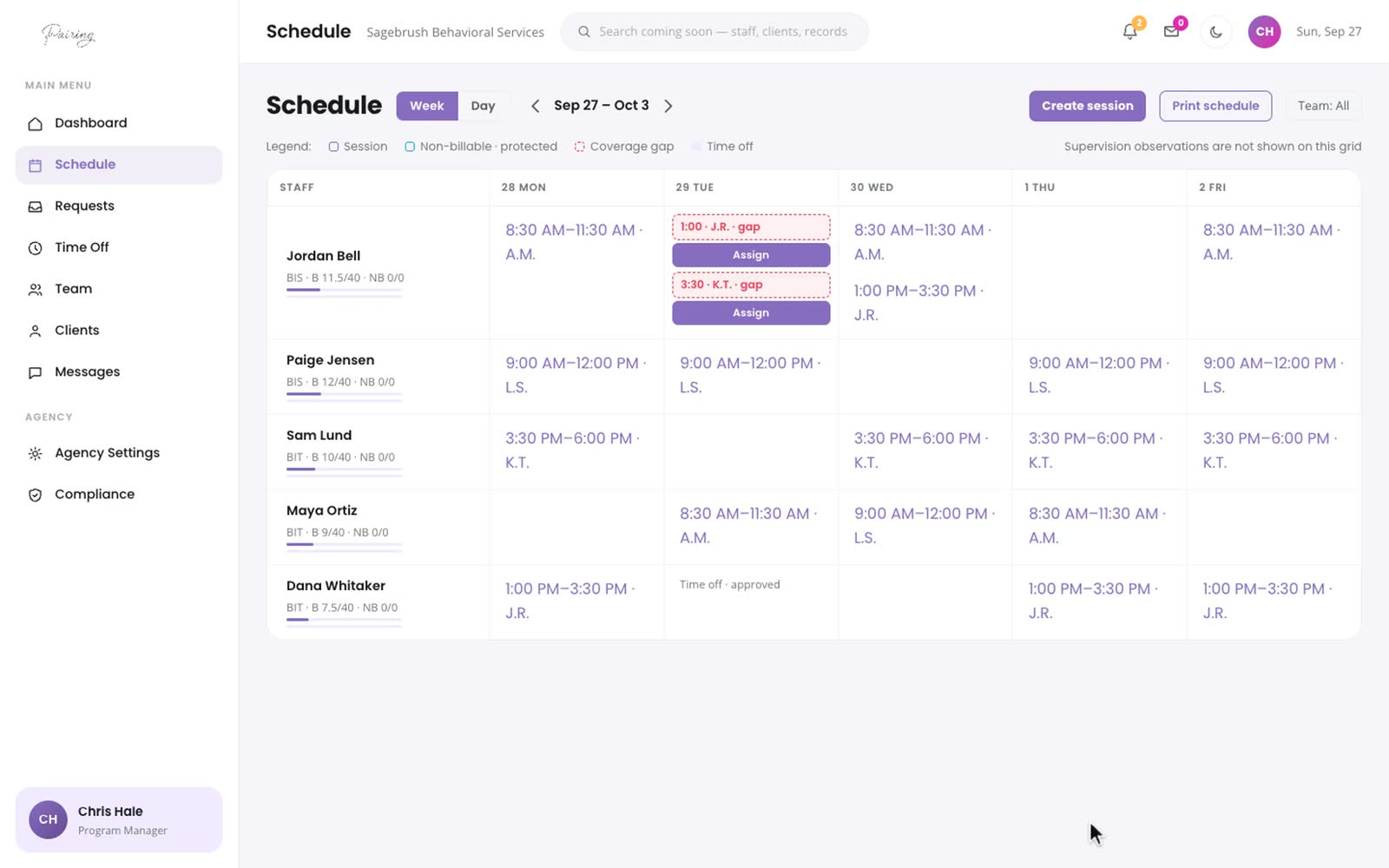
You should see every child and every session for the week on one screen, with who is working each one. An uncovered session should stand out without anyone hunting for it. Day and week views on a phone matter too, because supervisors and BIs spend most of the day away from a desk.
Covering a session
When someone calls out, the tool should suggest who could cover and still let you pick anyone. Before you confirm, you should see how the session changes that person's hours for the week. Ask what the tool checks at that moment: the qualification level on the child's authorization, and whether this BI has had PST for this child.
Time off
Requests should arrive in one place, in writing, with the dates and the notice given. Look for a clear approve or decline, a note that tells the BI why, and approved time off showing on the schedule. Ask how the tool helps you see the sessions a request touches before you approve it.
Supervision and PST
For each BI who needs monthly supervision, a supervisor should be able to see whether this month's observation has happened and whether the direction has been given. For each new pairing of a BI and a child, you want a record of PST: done, scheduled, or not done.
Treatment plan dates
Ask whether the tool warns you before a child's treatment plan expires, and whether it stops new sessions from being booked against an expired plan.
Messages and families
Schedule changes travel by message. Look for team boards and direct messages inside the tool, with read receipts, so you know who has seen a change without asking. If families get a view, check that a parent sees only their own child's sessions and the name of the BI coming, and that the view updates when a session changes.
Roles and records
Each role should see what its job needs: a BI their own sessions, a supervisor their team, a parent their own child. Ask for an audit log of who created or changed a record, and ask how you get all your data out if you leave.
Questions to ask any vendor
Fit for Idaho CHIS
- Have you worked with Idaho CHIS DDAs? Can we talk to one?
- Can the schedule track hours against each child's Idaho Medicaid prior authorization?
- Can we record each BI's qualification level and see it when we assign a session?
- What happens when we assign a BI to a child for the first time? Where do we record PST?
- How do we see which BIs still need supervision this month?
Day-to-day scheduling
- When a BI calls out, what does the scheduler do, step by step? Show us.
- How does time off work? What do we see before we approve a request?
- What do BIs see on their phones? What do parents see?
- Can you run the demo on a week that looks like ours instead of your sample data?
HIPAA and data
- Will you sign a Business Associate Agreement before we enter any client information? Can we read it first?
- Which subcontractors (hosting, messaging, support tools) handle our data, and do they have BAAs with you?
- Can we limit each role to what it needs, for example a BI seeing only their own sessions?
- Is there an audit log of who viewed or changed a record?
- If we leave, how do we get all our data out, and in what format?
Cost and commitment
- What would we pay per month at our current size, all in, including add-ons and setup?
- Is scheduling included, or is any part of it an add-on?
- Are there minimums or an annual contract?
- How long does setup take, and who does the data entry?
How to run a demo
Bring your messiest real week to every demo, with children's names and details removed. Ask the vendor to make your most common changes while you watch, such as a sick call and a new BI starting with a child, and count the clicks. Get the BAA answer in writing before anyone enters a child's information.
Pricing models differ. Some vendors charge per staff member, some per child, some per user, and some set minimums. Work out what each would cost for your headcount and caseload before you compare.
Where Pairing fits
Pairing is a scheduling and team-messaging app built for Idaho CHIS DDAs. Its week shows every child and every session with the BI working each one, and an open session stands out in red. When you cover a session, Pairing suggests BIs in a ranked list, shows how the session changes that BI's hours for the week, and asks about PST the first time a BI is paired with a child. Supervisors see each BI's observation and 1-on-1 status for the month, and the program manager's dashboard flags a treatment plan 30 days before it expires. Pairing works in any web browser, and the iPhone app is in testing. To see it with a week like yours, get in touch.
How this page was made
The rule text on this page comes from IDAPA 16.03.26, IDAPA 16.03.21, the Idaho Medicaid CHIS handbook chapter, the Department of Health and Welfare's CHIS supervision FAQ and the federal HIPAA regulations, all checked on September 26, 2026. The checklist names no vendors and applies to any tool, ours included. Drafted with AI assistance and reviewed by the Pairing team.
Other questions
What does scheduling software need to handle for an Idaho CHIS DDA?
The checks Idaho's rules put on the schedule: hours inside each child's prior authorization, cover at the qualification level the authorization names, participant specific training (PST) before a BI's first session with a child, and monthly supervision for BIs at the technician and specialist levels. Ask any vendor to show you each one working on a week like yours.
Can we keep scheduling on paper or in a spreadsheet?
Many DDAs do. The trade-off is that a person does all the checking by hand, such as keeping hours inside each authorization and tracking PST and supervision dates. If children's information goes into a cloud spreadsheet or calendar, that service is handling protected health information for you, so confirm your plan comes with a signed Business Associate Agreement (BAA).
How do we compare prices between scheduling vendors?
Ask each vendor for an all-in monthly cost at your current headcount and caseload, including setup and add-ons. Vendors charge per staff member, per child or per user, and some set minimums, so compare the totals.
What should we ask about HIPAA before choosing a vendor?
Ask whether the vendor will sign a Business Associate Agreement before you enter any client data, which subcontractors handle your data, whether you can limit each role to what it needs, whether there is an audit log, and how you get your data out if you leave.
Sources
- IDAPA 16.03.26, Medicaid Plan Benefits, Sections 180-186 (CHIS), effective July 1, 2026 · checked September 26, 2026
- IDAPA 16.03.21, Developmental Disabilities Agencies, Section 302.03: Participant Specific Training · checked September 26, 2026
- Idaho Medicaid Provider Handbook: Children's Habilitation Intervention Services (August 17, 2026), sections 2 and 4.3 · checked September 26, 2026
- Idaho Department of Health and Welfare: CHIS Frequently Asked Questions on Supervision for Providers (undated) · checked September 26, 2026
- HHS HIPAA rule: 45 CFR 160.103, definition of business associate (eCFR) · checked September 26, 2026
- HHS HIPAA rule: 45 CFR 164.502(e), disclosures to business associates (eCFR) · checked September 26, 2026