

A BI called out sick this morning. Now what?
A step-by-step plan for the morning a BI calls out: rank the day's sessions, pick a cover who fits the child's authorization and has had PST for the child, call the families, write it down, and keep one absence from spreading across the week.
When a BI (behavior interventionist) calls out sick, work in this order. First, look at every session they had today and decide which ones must be covered and which can move. Second, find cover among BIs who are qualified for the child's authorized service, have had participant specific training (PST) for that child, and have room in their hours. Third, call each family before the session would have started. Fourth, write down what happened. Then look at the rest of the week, because one call-out often turns into three gaps by Thursday. Where Idaho's rules decide the answer, we cite them. Everything else is operating practice, and we label it that way.
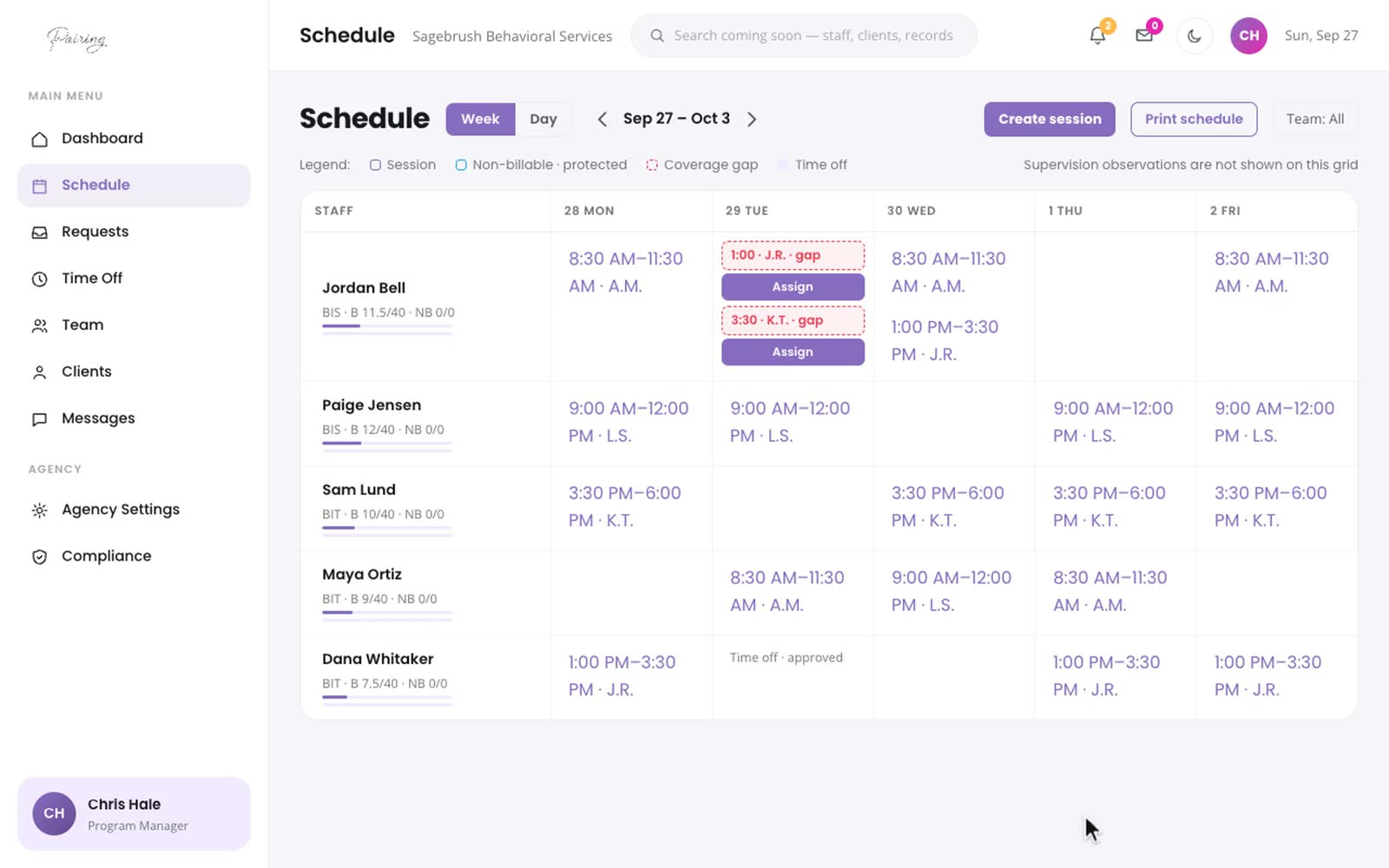
Our example throughout is a fictional agency, Sagebrush Behavioral Services. At 6:40 on a Tuesday morning, Dana, one of their BIs, texts that she has the flu. She had two sessions that day: J.R. at 1:00 and K.T. at 3:30. Chris, the program manager, builds the schedule.
First 30 minutes: decide which sessions to cover first
You rarely have enough people to cover everything, so rank the sessions. This ranking is practice, not law. Adjust it to your families and your clinical team's judgment.
| Cover first | Why |
|---|---|
| The earliest session | It has the least time to find cover or reach the family. |
| Children who have a hard time with missed sessions or changes in routine | Your supervisor or program manager knows who these children are. Ask them instead of guessing. |
| Sessions where the parent or guardian needs to be at work | A cancellation costs that family more than a single session. |
| Children whose weekly hours are already running short | Another missed session widens a gap that will show up in progress data. |
| Sessions that can move to later in the week | Often the best choice is to reschedule these instead of sending someone unfamiliar. |
At Sagebrush, J.R.'s 1:00 session comes first on time alone. K.T.'s parent works from home on Tuesdays, so K.T.'s 3:30 could move to Thursday if nobody qualified is free.
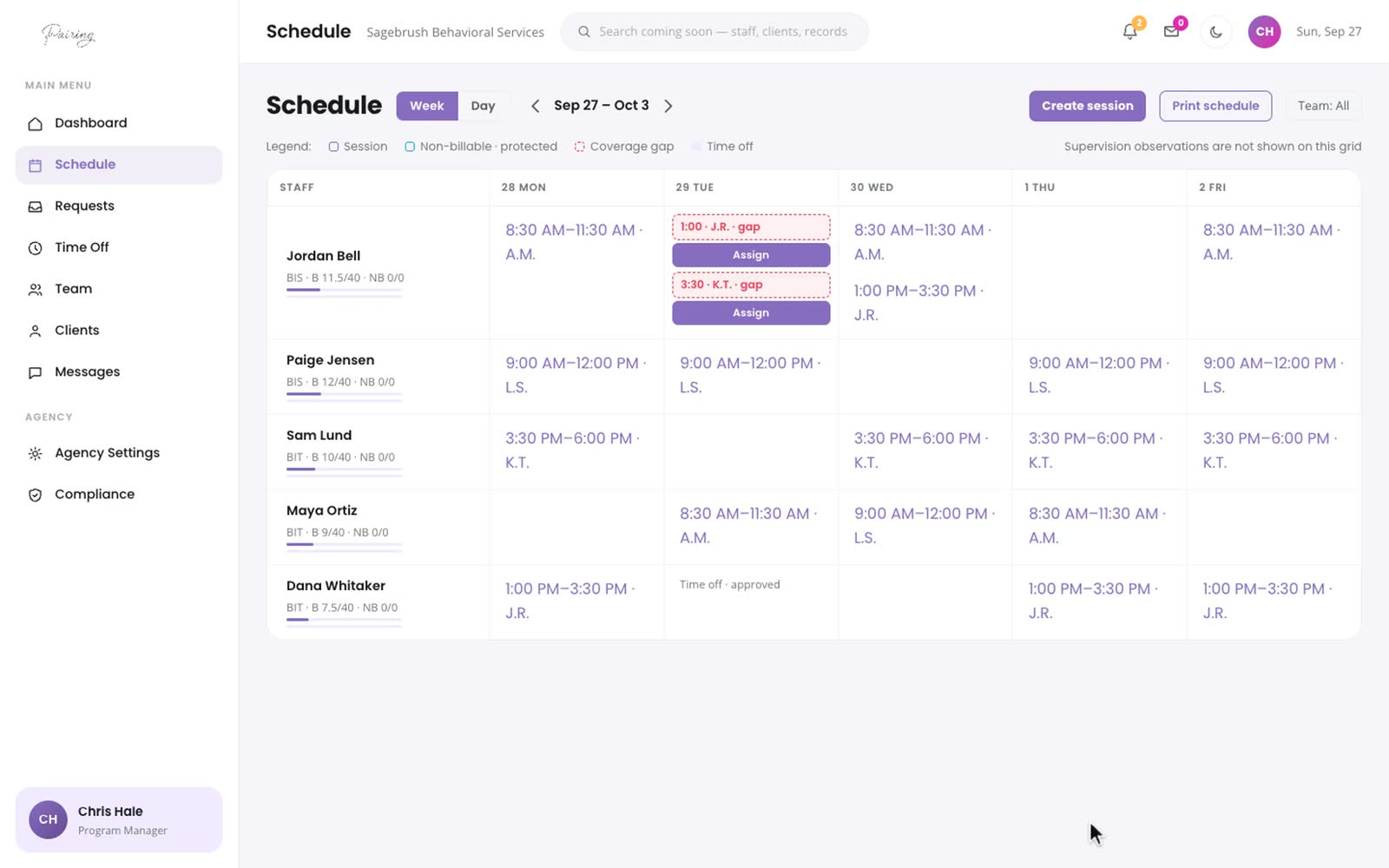
Before you make any calls, get the whole day in front of you. A week view that shows every open session answers "what's broken right now?" much faster than scrolling through Dana's calendar one appointment at a time.
Who can cover: the rules first, then the fit
This is where Idaho's rules matter most. A cover who isn't qualified for the service can turn a missed session into a documentation or reimbursement problem. Check these points in order.
They have to be your employee and cleared
Under IDAPA 16.03.26, CHIS is delivered by people who meet one of the state's qualification levels and are employed by a Developmental Disabilities Agency (DDA), or who enroll as independent providers (rule 184). BIs at the intervention technician level must be employees of a DDA (rule 184.02). The CHIS handbook adds that providers of direct care must have an Idaho Department of Health and Welfare background check clearance (handbook section 2). So you can't call in a friend of the agency, or a new hire whose clearance hasn't come back, however experienced they are.
They have to fit the child's authorization
Your agency may call all its direct staff BIs, but the rules sort them into qualification levels: intervention technician, intervention specialist and intervention professional, plus an evidence-based-model track. The handbook treats the two main services differently.
- Habilitative skill building. The handbook gives this exact situation as its example:
"...an intervention technician that is out sick for a week may reassign to another employee who meets the requirements of an intervention specialist and seek reimbursement for rendered services."
This works because skill building is billed under one code, with no modifier for the provider's qualification (handbook section 4.2). - Behavioral intervention. The authorization is tied to a qualification level. A higher-qualified employee can cover and bill at the authorized, lower rate. For example, an intervention professional can cover an intervention specialist's authorization. The opposite is not allowed (handbook section 4.3). In practice, cover goes up a level or stays level, never down.
Don't combine two children into one "group" session to make up for being short-staffed. Group services are reimbursed only when the child's objectives relate to benefiting from group interaction, and the ratio is one staff to two or three participants (rule 182.04). A staffing shortage is not a clinical reason.
They need PST for the child
CHIS DDAs are certified under IDAPA 16.03.21, and Section 302.03 of those rules, Participant Specific Training, says direct service staff "must be trained on the specific needs of the participant" before delivering services. A BI who has never had PST for this child can't be today's cover, however free they are. If nobody with PST for the child is available, moving the session may be the better call.
Watch for the birth-to-three requirements
If the child is under three, extra requirements apply. Intervention specialists and professionals serving that age group need additional supervised experience with infants and toddlers (rule 184.10, handbook section 2.10). Intervention specialists serving children under three must be supervised by someone who also meets the birth-to-three requirements (rule 183.04). Check that your cover meets them.
Then the fit: familiar faces first
Once the rules are satisfied, the rest is judgment. Our order of preference, which is practice and not law, is:
- Someone who has already worked with this child. They know the implementation plan, the child's reinforcers and the family's home, and the session is more likely to produce usable data. Our guide on keeping the same BIs with each child covers why this matters.
- Someone who knows the plan. The child's supervisor, if they're qualified and have time, may be a better cover than a BI who has never met the child.
- Someone with room in their hours. Look at each BI's week against their target and your overtime policy before you ask. A BI already at their limit who says yes is borrowing hours from next week.
- Someone who can get there on time. A cover who arrives 40 minutes late gives the family a short session and a bad day.
At Sagebrush, Sam has worked with K.T. before and is free at 3:30. K.T.'s session is behavioral intervention authorized at the intervention specialist level, and Sam qualifies as a specialist, so Sam takes it. Nobody who knows J.R. is free at 1:00. Paige has an open afternoon and completed PST for J.R. last month as his backup, though she hasn't run a session with him yet. J.R.'s session is skill building, so her level fits, and Chris assigns her.
Telling families
This is all practice, not law, but it's the part families remember.
- Call before the session would have started. A family getting their child ready for a 1:00 session should hear from you in the morning, not at 1:05 when nobody has arrived.
- Give them a choice when you can. For example: "Dana is out today. Paige, who has been trained on J.R.'s plan but hasn't worked with him yet, can come at 1:00, or we can move the session to Thursday at 1:00." Some children do better with a missed session than with a new face, and parents often know which.
- Say who is coming and whether the child knows them. A parent opening the door to a stranger is the fastest way to lose trust.
- Don't share why the BI is out. "Dana is out today" is enough. Her health is her business.
- Keep it off group threads. Contact each family on their own. If you send any written schedule details, include only what that family needs. Our guide on PHI in therapy schedules goes into this.
If the family declines the cover, write that down. It matters later when someone asks why a child received fewer hours than were authorized.
Keeping records of a covered or missed session
A covered session is documented like any other, by the person who delivered it. Idaho's rule requires, for each visit: the date, time and duration; a summary of the session; data that matches the implementation plan; the location; and the signature, date signed and credential of the individual providing the service (rule 183.03, handbook section 8). Paige signs J.R.'s note with her own credential, not Dana's.
The handbook also says records must be generated at the time the service is delivered (handbook section 8). The cover writes the note that day instead of leaving it for Dana when she's back. Idaho Medicaid's general provider handbook requires records of services submitted for reimbursement to be kept for at least five years from the date of service (General Information and Requirements for Providers, section 1.2.6).
The handbook also requires providers to check the child's Medicaid eligibility on the date of service and keep documentation of that check (handbook section 3). A change of staff doesn't change that step. Whoever handles it on a normal day should still do it.
For sessions that were cancelled or moved, no service was delivered, so there's no session note. We still recommend a short internal log of what happened (practice, not law):
- which session, and the original time
- who called out and when you learned of it
- who you contacted, and what the family chose
- the new time, if the session moved
Over a few months, that log shows you patterns you'd otherwise miss: the same child losing sessions again and again, or the same day of the week coming up short.
Preventing the domino effect across the week
Most call-out damage happens on Wednesday and Thursday, not Tuesday. Say Dana is out for three days. On Tuesday you move Paige to J.R., which leaves one of Paige's own children uncovered on Wednesday. Then you move someone else to cover Paige's child. By Thursday two BIs are over their hours and a supervision observation has been missed.
These habits (practice, not law) keep one absence from spreading:
- Look at the whole week before moving anyone. Before you reassign Paige, check what her move leaves open. If it only shifts the gap, you haven't fixed anything.
- Ask how long the absence will last. "Out today" and "out through Friday" call for different plans. For a multi-day absence, plan all the days at once instead of one morning at a time.
- Protect supervision. BIs at the intervention technician and intervention specialist levels must be supervised monthly, and supervision includes face-to-face observation (rules 183.04 and 184.02 to 184.03). If the session a supervisor planned to observe was cancelled, reschedule the observation now, not in the last week of the month. Our guide to Idaho CHIS supervision requirements has more detail.
- Build a bench. On normal weeks, have a second qualified BI complete PST for each child and learn their plan, under the supervisor's direction. When a call-out comes, you'll have a familiar face ready.
- Keep planned time off separate from call-outs. Vacations you approved weeks ago shouldn't use up the same slack you need for the flu. Our guide on time off without coverage gaps covers this.
- Review the call-out log monthly. Look for the same days, the same caseloads and the same families losing sessions. The fix may be a schedule change rather than a staffing change.
Where Pairing fits
Pairing is a scheduling and team-messaging app for Idaho CHIS DDAs. On its week, an open session stands out in red on the web and reads "Open slot" on iPhone. Open the session and Pairing suggests BIs in a ranked list, or you pick anyone. Before you confirm, you see how the session changes that BI's hours for the week. The first time a BI is paired with a child, Pairing asks whether they've completed PST for that child: trained, scheduled but not held yet, or not trained. The answer goes in a PST log. Families using the parent portal see the new BI's name on their child's week once the session changes.
Pairing works in any web browser, and the iPhone app is in testing. You can see what's built today on our features page, or get in touch to see it with a week like yours.
How this page was made
The Idaho rules on this page come from IDAPA 16.03.26 Sections 180 to 186, IDAPA 16.03.21 Section 302.03, the Idaho Medicaid CHIS handbook chapter (August 17, 2026 edition) and the Idaho Medicaid General Information and Requirements for Providers handbook. We checked all four in September 2026. Everything marked as practice is operating advice, not a legal requirement. Drafted with AI assistance and reviewed by the Pairing team.
Other questions
Can a BI at the intervention technician level cover a session authorized for an intervention specialist?
Not for behavioral intervention. The Idaho CHIS handbook (section 4.3) lets a higher-qualified staff member cover a lower-level authorization and bill at the authorized rate, and says the opposite is not allowed. Habilitative skill building is billed under a single code, and the handbook's own example (section 4.2) is an intervention technician out sick for a week being replaced by an employee who meets intervention specialist requirements.
Does a covering BI need participant specific training (PST) for the child?
Yes. IDAPA 16.03.21.302.03 says direct service staff must be trained on the specific needs of the participant before delivering services. If the only free BI hasn't had PST for this child, moving the session may be the better call.
Can we combine two children into a group session when we're short-staffed?
Not as a staffing fix. Under IDAPA 16.03.26.182.04, group services are reimbursed only when the child's objectives relate to benefiting from group interaction, with one staff member for two or three participants.
Who signs the session note when someone covers?
The person who delivered the session. Rule 183.03 requires the signature, date signed and credential of the individual providing the service, and the handbook says records must be generated at the time the service is delivered.
Do we have to document a cancelled session?
No service was delivered, so there is no session note. As a practice, not a rule, we recommend a short internal log of the call-out, who was contacted and what the family chose, so you can explain hour shortfalls and spot patterns later.
Sources
- IDAPA 16.03.26, Medicaid Plan Benefits, Sections 180-186 (CHIS), effective July 1, 2026 · checked September 26, 2026
- IDAPA 16.03.21, Developmental Disabilities Agencies, Section 302.03: Participant Specific Training · checked September 26, 2026
- Idaho Medicaid Provider Handbook: Children's Habilitation Intervention Services (August 17, 2026), sections 2, 3, 4.2, 4.3 and 8 · checked September 26, 2026
- Idaho Medicaid Provider Handbook: General Information and Requirements for Providers, section 1.2.6 (retention of records) · checked September 26, 2026