

How to say yes to time off without leaving a child's session empty
Time off turns into a problem when a session is left without a qualified BI. A one-page policy and a weekly review keep approvals and coverage in step.
The simplest way to handle time off without leaving a child's session uncovered is to treat every request as two jobs: find cover for each session the BI (behavior interventionist) would miss, then approve. Put that order in writing, review requests on a fixed day each week, and plan holidays and school breaks months ahead. Notice windows help, and your agency sets them; we found no Idaho rule on them. The state does care who steps in, and that they have had participant specific training (PST) for the child before they do.
Our examples use a fictional agency, Sagebrush Behavioral Services.
Most gaps from time off come from the order things happen in. A supervisor says "sure, have a great trip" in the hallway, the request gets written down later, and two weeks out the program manager finds four afternoon sessions with nobody in them. By then the likely covers have full weeks and haven't met the child. The fix is to make approval and coverage one step, so every yes comes with a name next to each affected session.
Write a simple time-off policy
A one-page policy does most of the work. BIs know what to expect, supervisors stop making hallway promises, and the person building the schedule has something to point to. We found no Idaho CHIS rule that sets notice periods for staff leave (we checked IDAPA 16.03.26 Sections 180 to 186 and the CHIS handbook in September 2026), so these numbers are yours to set.
A policy usually covers five things:
- How to ask. One written channel, after a word with their supervisor. Treat a mention in the hallway as a heads-up until the written request arrives.
- Notice windows. How far ahead you'd like requests, by length of absence.
- What approval depends on. State that you approve a request once every affected session is covered, or the family has agreed to a change.
- Busy periods. Which weeks are harder to approve, and how you decide between overlapping requests.
- How long you take to answer. For example, "you will hear back within one week of asking".
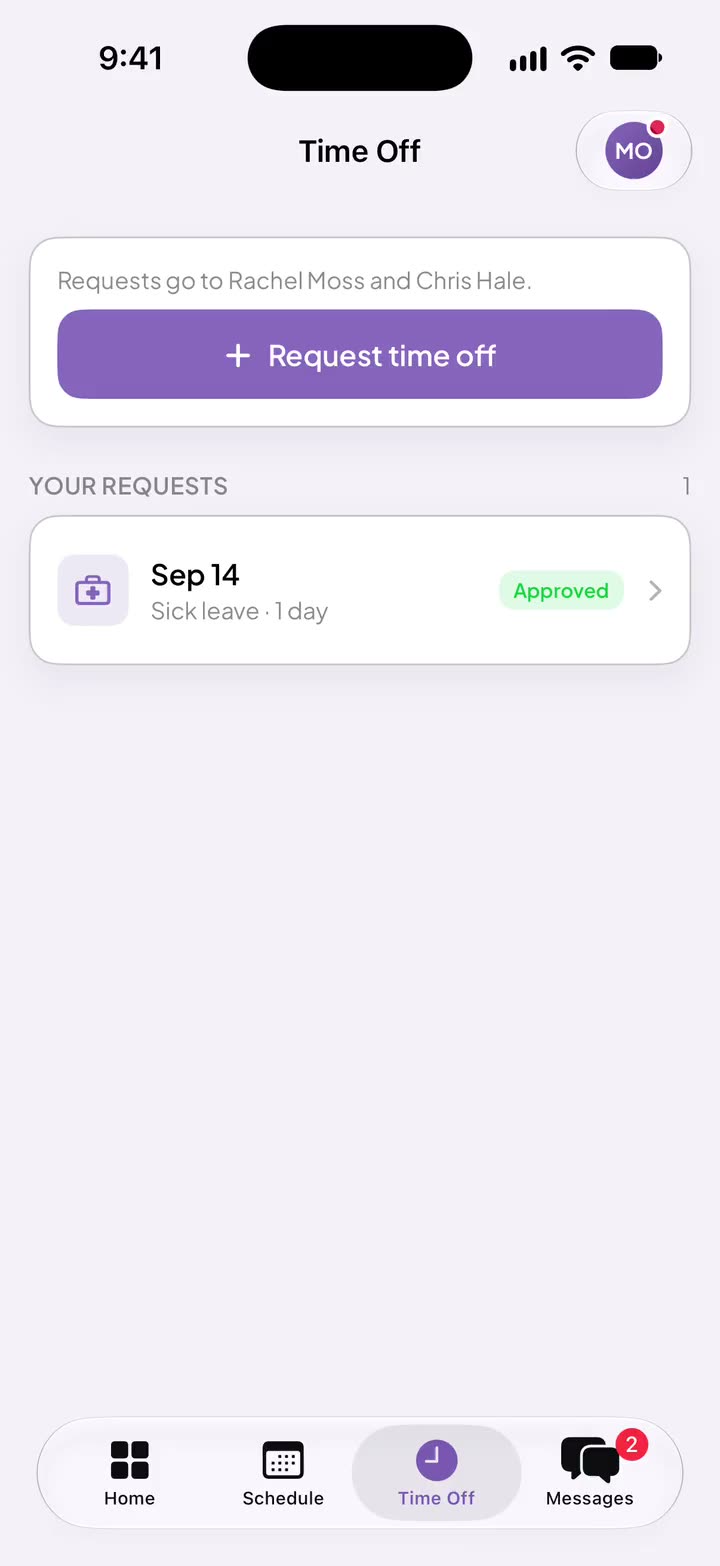
In Pairing, that one channel is the time-off request. A BI picks the day on the iPhone app or the web, confirms they spoke with their supervisor, and names who it was.
Sagebrush set its notice windows like this. Treat the table as a starting point.
| Length of absence | Sagebrush's preferred notice | Why they chose it |
|---|---|---|
| A single session or half day | 1 week | Usually one or two sessions to move or cover |
| 1 to 3 days | 2 weeks | Time to arrange PST for a cover on each child |
| A week or more | 4 weeks | Several children affected; families need time to plan |
| Holiday and school-break weeks | By a set date each year | Everyone wants the same weeks; see below |
The right numbers for you depend on how long it takes you to find a qualified cover and get them through PST for a specific child. If that takes ten days, a one-week notice window will keep producing gaps. Leave room for emergencies and medical leave too. A notice policy is for planned time off, and it should say so.
A weekly review routine
Time-off requests go wrong when you decide them one at a time, whenever someone asks. A fixed weekly review keeps them visible and shows you where they overlap. At Sagebrush, the program manager, Chris, and the supervisor, Rachel, spend twenty minutes on it every Tuesday.
- List open requests. Oldest first, so nobody waits longer than your policy says.
- For each request, list the affected sessions. Every child, every day, every time block the BI would miss.
- Look for overlaps. Two BIs off the same week is a different problem from one.
- Find cover or a change for each session. The next section covers who can step in.
- Decide. Approve the requests where every session is handled. For the rest, say what is missing and when you will look again.
- Tell people. The BI who asked, the covering BI, and the family.
If you can't cover a request, say so early and offer options: a shorter absence, different days, or a swap with a colleague. A clear "not yet" with a reason gives the BI something to plan around.
Cover before you approve
This is the core habit. Hold the approval until each affected session has one of these outcomes:
- a named BI who is qualified for the child's authorization and has had PST for that child,
- a session moved to another time the family has agreed to, or
- a session the family has agreed to skip, noted in writing.
"Qualified" and "ready" have specific meanings in Idaho CHIS. Three rules are worth knowing before you pick a cover.
Match the qualification the child is authorized for
The state sets qualification levels for CHIS staff in IDAPA 16.03.26 Section 184: intervention technician, intervention specialist and intervention professional, plus an evidence-based-model track. Your agency may call everyone at those levels a BI, but the level on the child's authorization decides who can cover. For behavioral intervention, the CHIS handbook is explicit about which way substitution can go:
If a provider has an authorization for behavioral intervention for an intervention specialist (IS), and the IS cannot provide services, the agency can reassign a higher qualified staff ... and bill at the intervention specialist rate as that is what the authorization is for. The opposite is not allowed.
In practice: if a child's authorization is for an intervention specialist, a BI at the intervention technician level can't cover it. An intervention professional can, at the authorized rate. Before you pencil in a cover, check the qualification on the child's authorization as well as who is free.
Some changes need an amendment first
Handbook section 6.4 lists changes that need a prior authorization amendment, and says you must submit the request before the change takes place. They include changing providers, splitting an authorization between providers, adjusting hours between staff qualification types, and adjusting staff qualifications. A few days of cover inside your own agency at the right qualification usually leaves the authorization alone. A longer absence that shifts hours to a different qualification might not. If you're unsure, check the current handbook before the time off starts.
The cover needs PST for the child
Every CHIS DDA is certified under IDAPA 16.03.21, and Section 302.03 of those rules, Participant Specific Training, says direct service staff "must be trained on the specific needs of the participant" before delivering services. A cover who has never had PST for the child needs it scheduled ahead of the session. That training time is the main reason notice windows exist. It also makes your best covers the BIs who already know the child, which is one more reason to keep a small, steady team around each child (see keeping the same BIs with each child).
One more check: under handbook section 2, a BI who hasn't completed their required annual training hours can provide CHIS only after they make the hours up. Make sure your cover is current before you rely on them.
Holidays and school breaks
Holiday weeks, spring break and summer are when the most BIs want time off, and often when families' needs change. Some children who usually have after-school sessions are home all day. Others travel and pause sessions for a week or two.
A few habits help:
- Ask families first. A month or two before a break, ask each family what their week will look like. You may find several sessions won't happen anyway, which frees BIs to take time off.
- Set a request deadline for peak weeks. For example, "requests for the last two weeks of December are due by October 15". Review them together instead of first come, first served.
- Cap how many people can be off at once. Base the cap on your ready-to-cover lists rather than a flat percentage.
- Be careful with make-up sessions. Before adding extra hours to make up for a missed week, check the child's authorization. The handbook's option for using weekly hours interchangeably across qualification types still says providers may not seek reimbursement for more than the authorized total per week. When in doubt, check the current handbook.
Plan your own agency closure days early too, and tell families in writing well ahead of time.
Being fair across staff
A coverage-first policy can turn unfair without anyone noticing. The BI who works with the hardest-to-cover child hears "not yet" more often, and in time leaves. A few ways to prevent that:
- Use the same rule for everyone. Decide overlapping requests by a written rule, such as order received, or rotating priority for peak weeks year to year.
- Spread readiness. If only one BI can work with a child, that child's schedule breaks the first time they're away. Get a second and third BI through PST for that child during normal weeks, so the first can take a vacation.
- Don't lean on the same cover. Keep a rough count of who covers for whom. The reliable BI who always says yes shouldn't absorb every absence.
- Explain every "not yet". Say what would change the answer: "If Sam completes PST for J.R. by the 10th, we can approve."
Communicating with families
For families, a change of face can matter as much as a missed session. Many children do better with people they know, and parents plan work around session times. Clear, early notice builds trust even when the news isn't what they hoped for.
- Tell them as soon as a change is confirmed. Wait until you have a plan, but don't wait until the day before.
- Say who is coming and whether the child knows them. "Sam, who worked with K.T. in June, will cover Tuesday and Thursday."
- Offer choices where you can. A new face, a moved time, or a skipped session. Some families prefer to skip rather than meet someone new.
- Write it down. A short written note avoids "I thought you said Wednesday".
- Keep health and personal details out of it. Families need the session plan. Why a BI is away stays private.
For what to do when an absence isn't planned, see covering a BI call-out.
Where Pairing fits
Pairing is a scheduling and team-messaging app for Idaho CHIS DDAs. BIs request time off from the iPhone app or the web, and each request shows that they spoke with their supervisor and who it was. Requests land in one queue, where a program manager or supervisor approves them, or declines them with a note. Approved time off shows on the schedule.
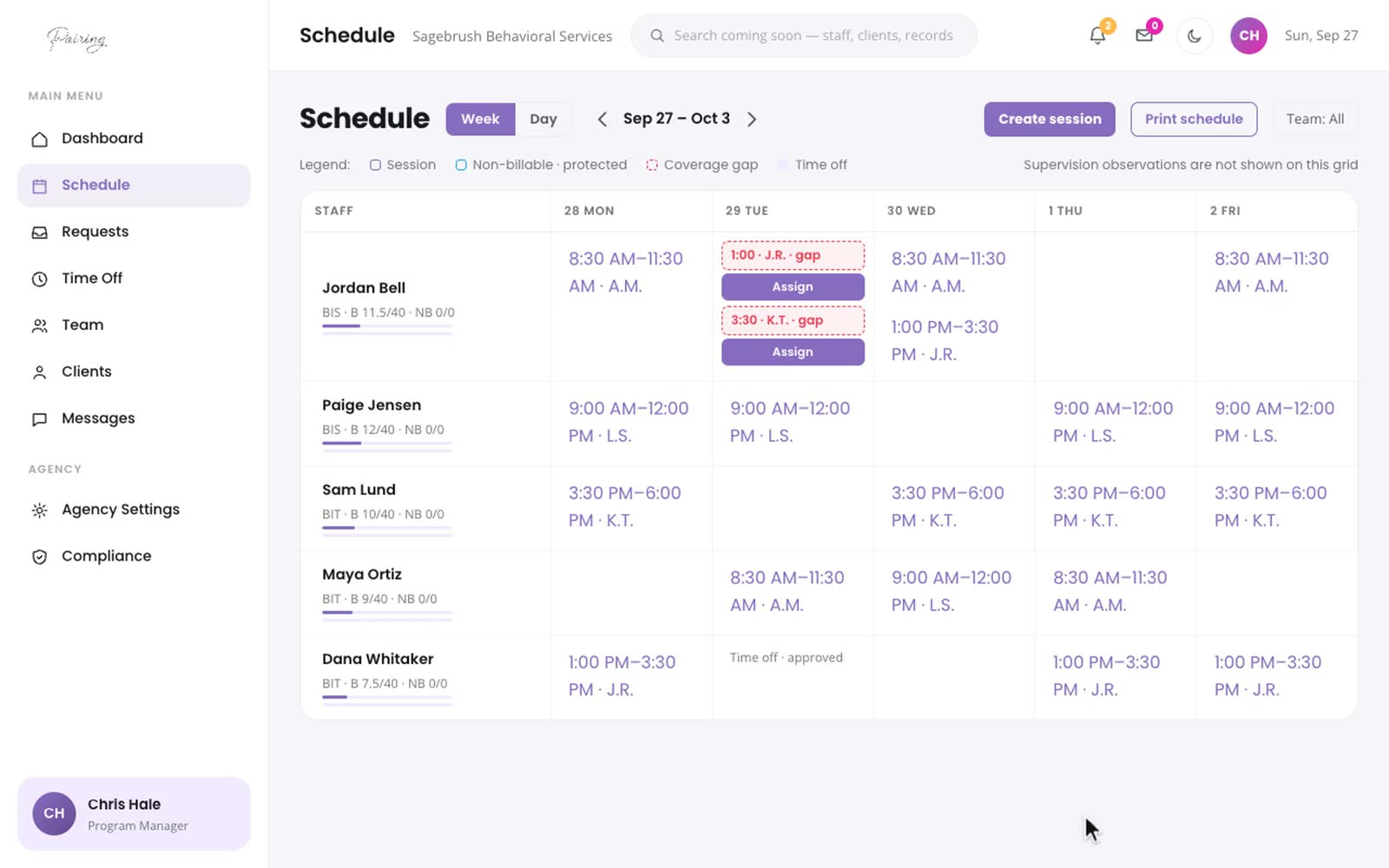
For the cover check in your weekly review, Pairing's week shows every child's sessions with the BI working each one, and an open session stands out in red. Families using the parent portal see their own child's week with the name of the BI coming to each session, and their view changes when a session does. Pairing works in any web browser, and the iPhone app is in testing. To see it alongside your own time-off policy, get in touch.
How this page was made
The Idaho rules on this page come from the CHIS chapter of the Idaho Medicaid Provider Handbook (published August 17, 2026), IDAPA 16.03.26 Section 184 and IDAPA 16.03.21 Section 302.03, all checked in September 2026. Everything else is general operating advice, not a state requirement. Drafted with AI assistance and reviewed by the Pairing team.
Other questions
Does Idaho require a minimum notice period for staff time off at a CHIS DDA?
We did not find one in IDAPA 16.03.26 Sections 180 to 186 or the CHIS handbook when we checked in September 2026. Notice windows are an agency policy choice. Pick numbers that match how long it takes you to find a cover and get them ready for the child.
Can a BI at the intervention technician level cover a session authorized for an intervention specialist?
No. The CHIS handbook (section 4.3) allows a higher-qualified staff member to cover a behavioral intervention authorization for a specialist and bill at the specialist rate. The opposite is not allowed. Check the child's authorization before you assign cover.
Does a covering BI need participant specific training (PST) for the child first?
Yes. IDAPA 16.03.21.302.03 says direct service staff must be trained on the specific needs of the participant before delivering services. Arrange that training before the covered session, not on the day.
What if we cannot cover a session during someone's approved time off?
Tell the family early, offer a make-up time if the authorization allows it, and write down what happened. If you often cannot cover, look at staffing: the schedule is telling you that you are short of BIs who know the child.
Sources
- Idaho Medicaid Provider Handbook: Child Habilitation Intervention Services (published Aug 17, 2026), sections 2, 4.3 and 6.4 · checked September 26, 2026
- IDAPA 16.03.26, Medicaid Plan Benefits, Section 184: qualifications and duties of CHIS staff (effective July 1, 2026) · checked September 26, 2026
- IDAPA 16.03.21, Developmental Disabilities Agencies, Section 302.03: Participant Specific Training · checked September 26, 2026